Creators Agency Research / July 2026
10,000 Sponsored YouTube Videos
Where brands buy, where they return, and how marketers can build smarter YouTube sponsorship tests.
Check your inbox for the email from Apple. The full PDF is attached.
The short version
Three findings marketers can use before the next campaign
We used a fixed 10,000-video market sample to study where sponsorships happened, where the same buyer returned, and how sponsored videos compared with each channel's usual views. We then looked at a separate set of 272 brand programs managed by Creators Agency to see which launch patterns were followed by later buying.
showed an observed renewal
531 of 1,948 eligible brand-and-channel pairings
What this means: most eligible first buys did not show a return inside the study window. Decide before launch what results would earn more budget.
met or beat usual views
Among 3,170 comparable sponsor videos posted in 2026
What this means: sponsorship did not mean weaker reach overall in this sample. Plan from a creator's usual views, then expect individual videos to vary.
as likely to keep buying after six months
Managed programs: 50% with 2+ creators in the first 30 days versus 22% with one
What this means: if budget allows, start across several creators with the same goal and tracking. Then put more budget behind the strongest fits.
The first two figures come from the 10,000-video market sample. The 2.3× figure comes from a separate cohort of 272 managed brand programs. It is an observed association, not proof that starting with more creators caused later buying.
Selected findings
What the market shows. What it does not.
The important numbers, methods, and limits are public. You do not need to enter an email to understand or cite the work.
Channel size
Mid-sized channels had the highest observed renewal rate
Half of the sponsor videos we could size ran on channels below 50,000 usual views. Those smaller channels were used most, but the middle band showed more same-brand returns inside the study window.
Do not treat channel size as a shortcut for quality. Build the first test across more than one size band, then compare reach, cost, and your own business results.
Buyer fit
Business-only brands bought mostly in B2B, then renewed more often elsewhere
Business-only brands placed 64.1% of weighted sponsor activity with B2B creators. Yet the observed renewal rate was 34.1% outside that creator niche versus 22.6% inside it.
The most-used lane is not always the clear return winner. Keep category fit at the center, but give broader-interest creators a fair test around real product use cases.
1.5× the observed renewal rate outside the B2B creator niche
Sponsored-video views
The middle result held up, but individual videos still swung widely
The median sponsored video reached 105.8% of its channel's usual views. At the same time, 15.7% fell below half of usual views and 28.3% reached at least 1.5 times usual views.
Use usual views—not subscriber count alone—to plan reach. Test enough videos to learn how a creator performs for your brand instead of judging the partnership from one result.
Managed programs
Brands that started with more creators were more likely to keep buying
In a separate cohort of 272 Creators Agency-managed brand programs, 50.0% of brands that used at least two creators in their first 30 days recorded another managed YouTube placement after day 180. That compares with 22.0% of brands that used one creator in their first 30 days. Among the 115 brands active again more than 60 days after launch, 87 expanded beyond the creators used on their first recorded day.
A broader opening round creates a real comparison set. If budget allows, use the same goal and tracking across several creators, then buy more with the strongest fits while continuing to test nearby audiences.
2.3× as likely to record another managed placement after day 180
Inside the report
The data behind the headline numbers
The 18-page report adds the comparisons, denominators, definitions, and limits that turn a market pattern into a useful test idea.
- 01Which brand categories sponsored the most videos
- 02The ten most active sponsor brands in the sample
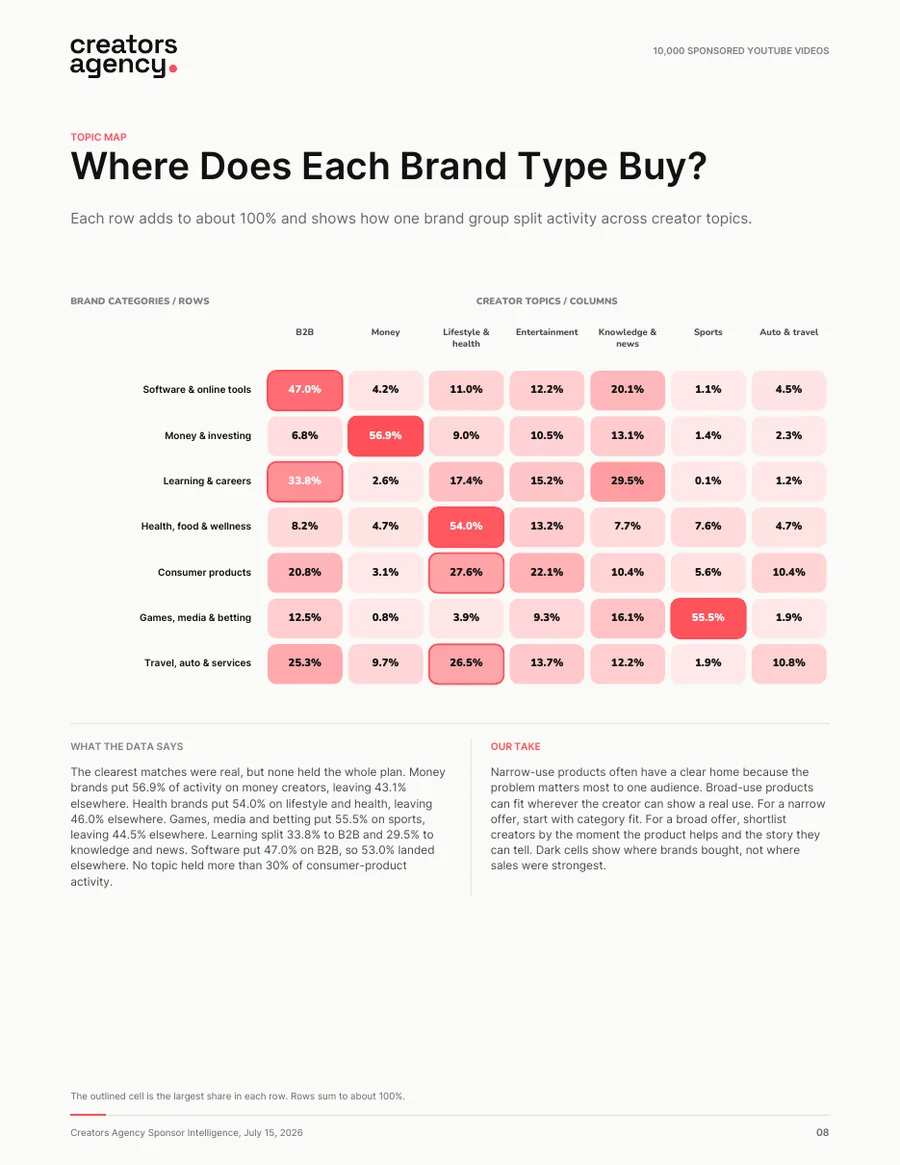
- 03Where each brand type bought across creator topics
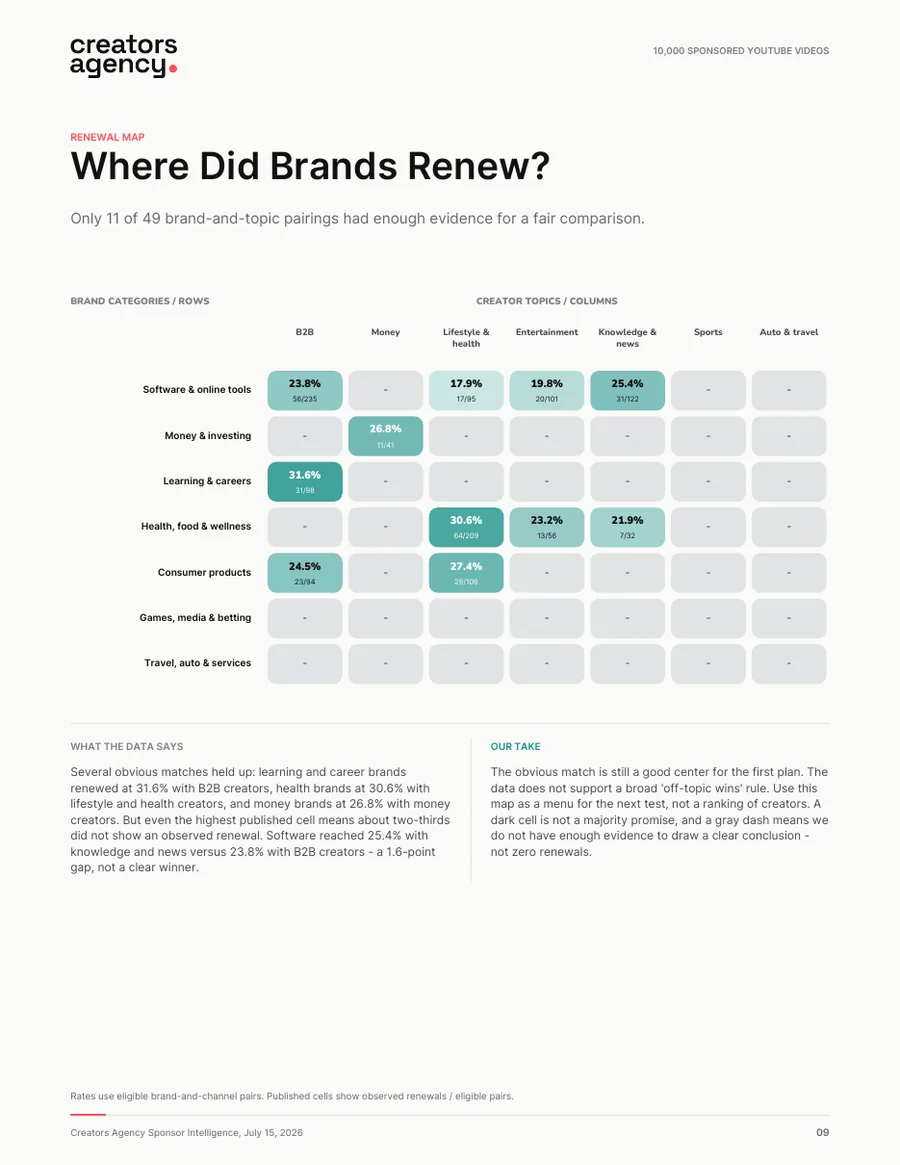
- 04Where the same brands returned on the same channels
- 05How activity and renewal changed by channel size
- 06Why software led activity but not renewal
- 07How sponsored-video views compared with usual views
- 08How a broader launch related to buying after six months
- 09How to decide when to keep, expand, validate, or stop
Explore the data by question
These public briefs pull one practical answer at a time from the same fixed sample, with a table, interpretation, and limits.
Do sponsored YouTube videos get fewer views?
Among 3,170 comparable videos, 53.5% met or beat the channel's usual views.
Read the brief → Sponsor categoriesWhat kinds of brands sponsor YouTube videos?
Compare weighted activity and brand count across 12 sponsor categories.
Read the brief → Channel sizeWhere do sponsorships happen by usual views?
See which size was used most and which had the highest observed renewal.
Read the brief → SoftwareSoftware YouTube sponsorship benchmarks
See where software and online-tool brands appeared and returned.
Read the brief → Sponsor listThe most active sponsors in our sample
Compare appearances, channels, and concentration for the top ten brands.
Read the brief →Methodology
How we built and read the research
The report combines a fixed market sample from Creators Agency's sponsor-detection archive with a separate cohort of managed brand programs. Neither study promises results for an individual campaign.
- 10,000sponsored videos in the fixed random sample
- 4,365brand-and-channel pairings in the sample
- 1,948pairings old enough for a full-year renewal check
- 531pairings with an observed renewal
Core definitions
- Observed renewal
- After the first sampled appearance, the same brand appeared again on the same channel within 365 days and more than 60 days after the prior sampled appearance.
- B2B creator topic
- Business, careers, tech, and AI channels. Each channel received one primary-topic classification.
- Business-only brand
- A brand that sells only to businesses. Brands that sell to both people and businesses were kept in a separate group.
Main limits
- Renewal is a signal, not ROI. It does not prove a new contract, sales, profit, or campaign quality.
- The sample has edges. A real return outside the 10,000-video sample is not counted.
- Channel size is current. Usual views are current, not subscriber count or size at the time of the deal.
- Multi-sponsor videos are weighted. Activity is split evenly across sponsors so the weighted total remains 10,000.
- Managed-program results are descriptive. They show an association between launch breadth and later buying, not proof that one caused the other.
Why some renewal-map cells are blank
A brand-and-topic pairing needed at least 30 eligible pairs, five brands, and 20 channels. No one brand could make up more than 40% of the pairs, no one channel more than 15%, and the uncertainty range could not be wider than 30 points. A dash means there was not enough evidence to publish a fair comparison—not zero renewals.
How we read the managed-program cohort
We grouped 272 brand programs by whether they used one creator or at least two creators in their first 30 days, then checked for another managed YouTube placement after day 180. Separately, among brands active again more than 60 days after launch, we checked whether later placements included a creator outside the group used on the brand's first recorded day. These comparisons describe what happened in our managed work; they do not isolate the effect of launch size from budget, brand readiness, creative quality, or other factors.
Citation and reuse
Use the numbers. Keep the context.
You may quote the public findings with attribution. Please link to this page so readers can see the sample, definitions, and limits behind the statistic.
Creators Agency. (2026, July 15). 10,000 Sponsored YouTube Videos. Creators Agency Sponsor Intelligence. https://creatorsagency.co/research/10000-sponsored-youtube-videos
Free research report
Get the full 18-page report
Get the designed 18-page PDF with all charts, denominators, interpretations, and research notes.
Check your inbox for the email from Apple. The full PDF is attached.